
The DTC
Back to all articles
Hazard Perception Test: How the New 2026 Clips Work

The DTC Blog

Hazard Perception Test: How the New 2026 Clips Work

Chris Jackson• Published 11 August 2026"Theory Test"

The DVSA has added new hazard perception clips for bad weather, low light and night driving. Learn how the 2026 clips work, what changed, and how to practise for them.

What is the hazard perception test?

The hazard perception test is the second part of the UK car theory test. It measures your ability to spot developing hazards — things that happen on the road that would make you change speed or direction.

You will watch 14 video clips. Thirteen clips contain one developing hazard, and one clip contains two. You score points by clicking the mouse as soon as you see the hazard start to develop.

The scoring window opens when the hazard begins and closes once the situation has fully developed. The earlier you spot it, the more points you can score. Each hazard is worth up to 5 points.

What changed in 2026?

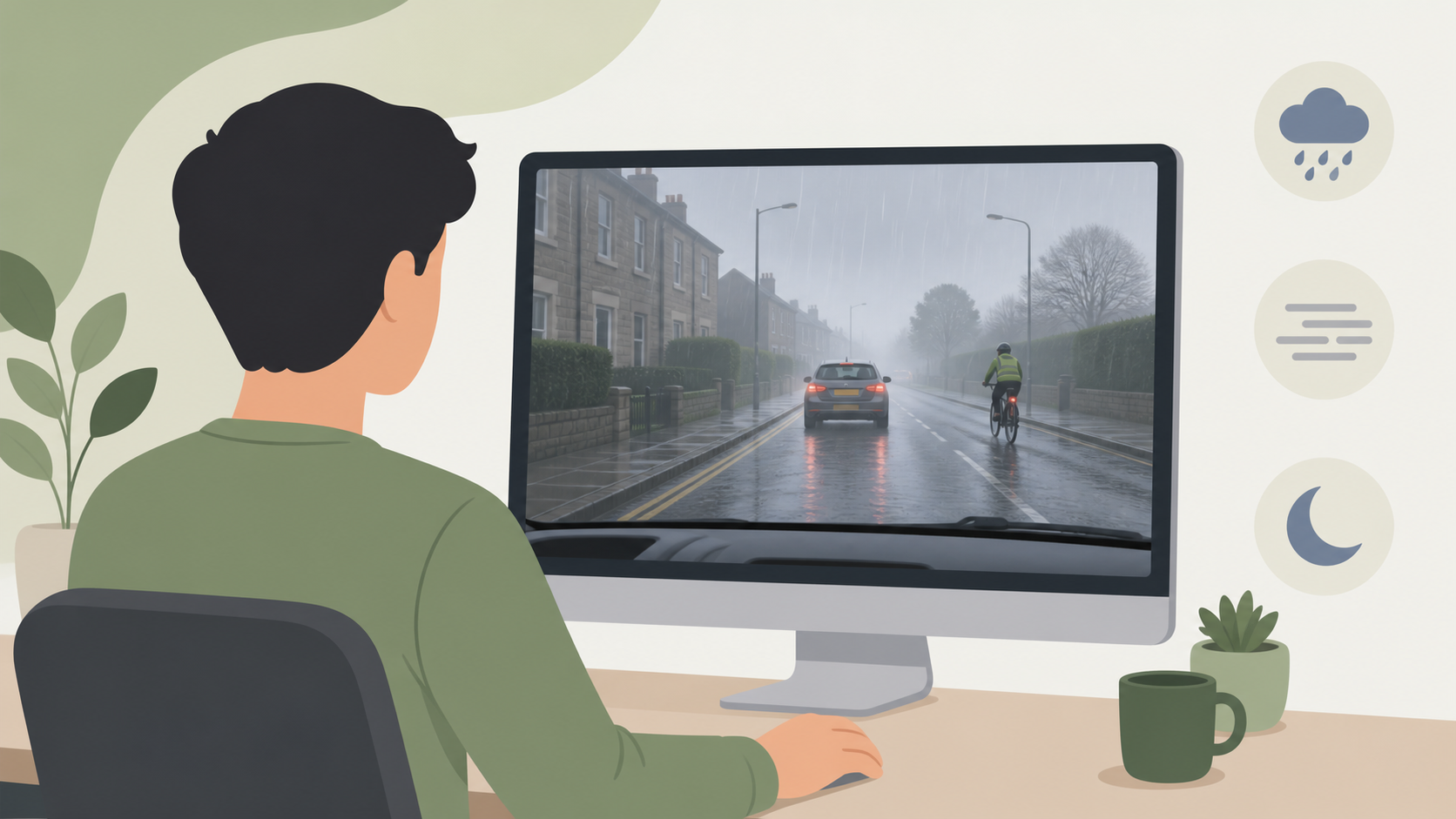
The DVSA has added new computer-generated clips that show driving in more challenging conditions. The change is designed to test how well learners spot hazards when visibility is poor or the road surface is more dangerous.

The new clips include scenarios in:

  • fog
  • rain
  • snow and ice
  • wind
  • dawn and dusk
  • night-time and low-light conditions

Importantly, the test format, pass mark and scoring system have not changed. You still watch 14 clips, you can still score up to 5 points per hazard, and you still need 44 points out of 75 to pass the car theory test.

Why the DVSA added these clips

Bad weather is a real safety issue. Department for Transport data shows that thousands of reported accidents happen in rain, sleet, snow or fog each year. When roads are wet or icy, stopping distances can double or even increase tenfold.

By adding clips in poor weather and low light, the DVSA wants to make sure learners are thinking about hazards in conditions they will actually face after passing their test. The aim is safer drivers for life, not just test-takers.

Research from the Department for Transport has shown that hazard perception training and testing could reduce collisions by around 11%.

What a developing hazard looks like

A developing hazard is something that changes from a normal road feature into a situation that requires action.

For example, a parked car on the side of the road is not a hazard. But when its indicator starts flashing and it begins to pull out, it becomes a developing hazard. You would need to slow down or change position, so that is the moment to click.

In the new weather clips, hazards may be harder to see at first. A pedestrian might step out from behind a parked van in heavy rain, or a cyclist might appear suddenly in low light. You still click when the hazard starts to develop.

How scoring works

  • Each developing hazard is worth up to 5 points.
  • Click as soon as the hazard starts to develop for the maximum score.
  • You do not lose points for clicking incorrectly.
  • Clicking repeatedly or in a pattern will score zero for that clip.
  • You only get one attempt at each clip and cannot review your answers.

The car theory test pass mark for hazard perception is 44 out of 75. For the multiple-choice part, the pass mark is 43 out of 50. You need to pass both parts at the same appointment.

What the new clips show

Condition What to watch for
Rain Reduced visibility, longer stopping distances, spray from other vehicles, pedestrians with umbrellas, cyclists taking shelter
Fog Slow-moving traffic, hidden junctions, pedestrians near the kerb, vehicles appearing suddenly out of the mist
Snow and ice Slippery surfaces, reduced grip, slower traffic, pedestrians walking in the road, vehicles struggling to stop
Wind High-sided vehicles moving unexpectedly, debris on the road, cyclists buffeted by gusts, branches falling
Dawn and dusk Low sun glare, poor contrast, drivers forgetting lights, pedestrians and cyclists in dark clothing
Night Limited visibility beyond headlights, dazzle from oncoming traffic, pedestrians crossing in unlit areas, parked vehicles with no lights

How to practise for the new clips

You do not need to have practised with the exact new clips to pass the test. The hazard perception skill is the same regardless of weather or light. However, it helps to practise in conditions that test your eye for hidden or delayed hazards.

Good practice habits include:

  • Use official DVSA materials. They are the most accurate reflection of the test format.
  • Practise daily in short bursts. Ten minutes a day beats one long session a week.
  • Click once when the hazard starts. Do not click repeatedly; the system can score you zero.
  • Watch the edges of the clip. Hazards often enter from the side of the frame.
  • Think like a driver. Ask yourself: "What could make me brake, steer or slow down?"

Common mistakes to avoid

  • Clicking too early. Wait until the hazard is actually starting to develop, not when it is just a possible risk.
  • Clicking too late. If the hazard has fully developed, the scoring window may already be closing.
  • Clicking in a pattern. The system detects rhythmic clicks and scores zero.
  • Overthinking. Trust your first reaction when something starts to change.
  • Ignoring the clip conditions. Rain and darkness mean hazards appear later and are harder to spot. Adjust your expectations.

What happens on test day

The hazard perception test is taken immediately after the multiple-choice questions at the same theory test centre. You sit at a computer with a mouse.

Before the clips start, you will see a short video explaining how the test works. You cannot skip this. Then the 14 clips play one after another. You cannot pause, rewind or replay them.

At the end, your score is added to your multiple-choice score. You will usually get your result within minutes.

Top tips for passing hazard perception

  1. Stay calm. The clips move quickly but you only need one good click per hazard.
  2. Keep your eyes moving. Scan the whole frame, not just the centre.
  3. Expect hazards in bad weather to appear suddenly and be harder to see.
  4. Practise with the volume low or off, since the real test has no audio.
  5. Use the official DVSA YouTube examples to familiarise yourself with the clip style.

Frequently asked questions

Did the hazard perception pass mark change in 2026?

No. The pass mark for the car theory test hazard perception part is still 44 out of 75.

How many clips are in the hazard perception test?

There are 14 clips in total. One of them contains two developing hazards, and the rest contain one each.

Do I need new apps to practise the 2026 clips?

No. Existing hazard perception practice materials still work because the skill being tested is the same. The DVSA says any products you have been using are still relevant.

Can I click more than once on a hazard?

You can click more than once, but clicking continuously or in a pattern will score zero. Click once when the hazard starts to develop, and again only if you are sure it has entered a new phase.

Are the clips real video footage?

The clips are computer-generated imagery (CGI). The DVSA moved to CGI clips in 2015 so they could be updated more easily and show a wider range of road conditions.

What happens if I fail hazard perception?

If you fail the hazard perception part, you fail the whole theory test, even if you pass the multiple-choice questions. You need to wait at least 3 working days before rebooking.

Will I definitely get the new weather clips?

The new clips are part of the pool of possible clips. You may see some, all or none of them on your test, depending on which clips are randomly selected.

Summary

The 2026 hazard perception update adds clips in rain, fog, snow, wind, low light and night-time conditions. The test itself has not changed: 14 clips, up to 5 points per hazard, 44 out of 75 to pass. The best way to prepare is to practise spotting developing hazards early, stay calm on test day, and remember that hazards in poor conditions may appear later and be harder to see.

C

Chris Jackson

DVSA-approved driving instructor with more than five years of practical teaching experience.

Published 11 August 2026
#"hazard perception"#"theory test"#"DVSA"#"driving test"#"new clips 2026"#"night driving"#"bad weather driving"

Related posts