
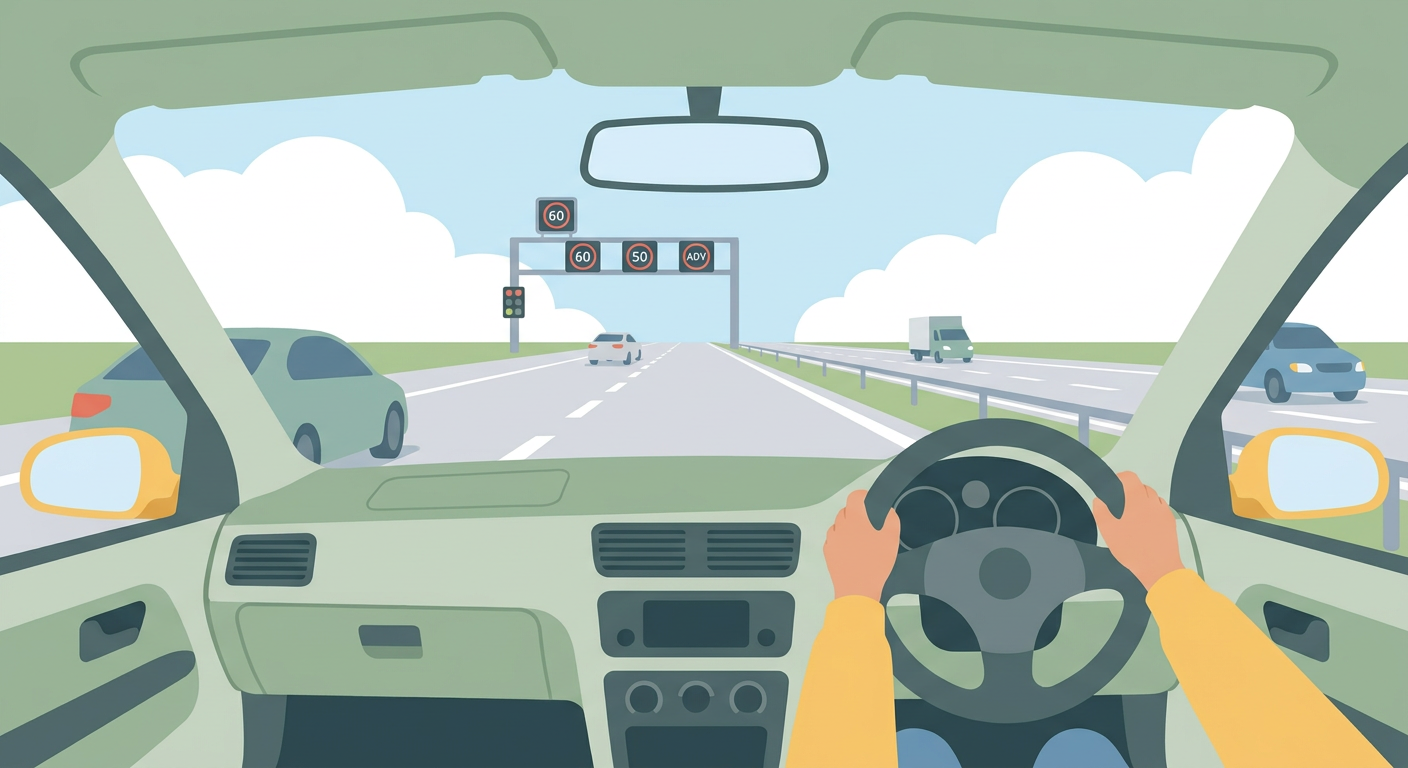
Motorway Driving for Newly Qualified Drivers
Passing your test is just the start. Learn how to drive safely and confidently on UK motorways, from joining and leaving to smart motorways, speed limits and breakdown safety.
On this page
Why motorway driving matters for new drivers
Passing your driving test is a huge milestone, but it is not the end of your learning. For most new drivers, the first solo motorway journey is one of the most daunting experiences they face. The speeds are higher, the traffic is heavier, and the consequences of a mistake are more serious.
Since June 2018, learner drivers in England, Scotland and Wales have been allowed to take motorway lessons with an approved driving instructor in a dual-control car. That means many new drivers now have some supervised motorway experience before they pass. Even so, driving alone on a motorway for the first time is different. This guide covers the key skills and rules you need to stay safe and confident.
Before you drive on a motorway
A little preparation makes a big difference. Before a motorway journey:
- Plan your route. Know which junctions you need and which lane to be in well before your exit.
- Check your car. Tyres, oil, coolant, lights, fuel and screen wash should all be in good order.
- Allow extra time. Motorway driving is safer when you are not rushing.
- Avoid driving tired. Long stretches of motorway can cause drowsiness.
- Remove distractions. Set your sat nav and music before you set off.
How to join a motorway safely
Joining a motorway means using a slip road to accelerate and merge with fast-moving traffic. The slip road is designed to give you time to build speed.
- Use the slip road to accelerate to a speed that matches the traffic in lane 1.
- Check your mirrors and blind spot before moving onto the motorway.
- Give priority to traffic already on the motorway. Do not force your way into a gap.
- Signal early so other drivers can see your intention.
- If traffic is heavy and the slip road is short, adjust your speed and be prepared to wait for a safe gap.
Lane discipline on the motorway
The Highway Code is clear: you should drive in the left-hand lane unless you are overtaking. This is one of the most important rules on a motorway and one that many drivers forget.
- Lane 1: Normal driving lane. Return to this lane after overtaking.
- Lane 2 and 3: Overtaking lanes only. Move left again once you have finished overtaking.
- Lane hogging is an offence. Staying in the middle lane when the left lane is clear can result in a fine and points on your licence.
When overtaking, use the mirror, signal, manoeuvre routine. Check your mirrors and blind spot, signal, move out smoothly, pass the vehicle, then move back in when it is safe.
Speed limits and stopping distances
The national speed limit for cars on UK motorways is 70 mph unless signs tell you otherwise. Speed limits on motorways are enforced by speed cameras, average speed cameras and police patrols.
Stopping distances increase dramatically at higher speeds. At 70 mph in dry conditions, your thinking distance plus braking distance is around 96 metres, or roughly 24 car lengths. In wet weather, double that distance. In icy or snowy conditions, it can be up to 10 times greater.
Keep a two-second gap to the vehicle in front. In wet weather, increase this to at least four seconds. If the road is icy or foggy, increase it even more.
Smart motorways: what new drivers need to know
Smart motorways use technology to manage traffic. There are three types:
| Type | What it means |
|---|---|
| Controlled motorway | Has a permanent hard shoulder with variable speed limits and lane control signs |
| Hard shoulder running | The hard shoulder is sometimes opened as a live traffic lane when traffic is heavy |
| All lane running | There is no hard shoulder. Emergency refuge areas are provided at intervals |
On a smart motorway you must:
- obey the red X sign ❌ — it means the lane is closed and you must move out
- keep to variable speed limits shown on overhead signs
- use emergency refuge areas if you cannot leave at the next junction
- not stop on the motorway unless it is an emergency
If you see a red X above your lane, move out safely as soon as you can. Driving under a red X is dangerous and can result in a fine.
How to leave a motorway
Leaving the motorway needs planning. Follow these steps:
- Watch for junction signs from one mile away.
- Move into the left-hand lane in good time.
- Signal left at the 300-yard marker.
- Use the slip road to reduce speed gradually. Remember, slip roads can curve sharply.
- Adjust to the speed limit of the road you are joining.
If you miss your exit, do not swerve or reverse. Continue to the next junction and come back.
Overtaking on the motorway
Overtake only when necessary and always on the right. Undertaking is dangerous and usually illegal.
Before overtaking:
- check the road ahead is clear enough to complete the manoeuvre without cutting in
- check your mirrors and blind spot
- signal clearly and in good time
- accelerate smoothly to pass the vehicle
- move back to the left lane once you are safely past
Do not overtake if you are not sure you have the speed, space or time to complete the move safely.
Driving near large vehicles
Lorries, coaches and vans behave differently from cars on motorways. They take longer to stop, have larger blind spots, and can be affected by strong wind.
- Do not linger alongside a large vehicle. Pass it promptly or drop back.
- Be aware of spray from lorries in wet weather, which can temporarily blind you.
- Give extra space when a large vehicle is changing lanes or overtaking.
- Expect lorries to be limited to 56 mph or 60 mph.
What to do if you break down
Breaking down on a motorway is stressful, but staying calm and following the right steps keeps you safe.
- Try to leave at the next junction or pull into a service area if you can.
- If you cannot leave, get to the left-hand verge or an emergency refuge area.
- Leave the vehicle by the left-hand door and stand behind the barrier, well away from traffic.
- Call for help. Use an emergency phone or dial 999 if you are in a dangerous position.
- Stay out of the car. Do not wait in the vehicle or attempt repairs on the hard shoulder.
On a smart motorway without a hard shoulder, emergency refuge areas are spaced at roughly 1.5-mile intervals. They have a phone that connects directly to a control centre.
Tiredness and long journeys
Motorway driving can be monotonous, and tiredness is a major risk. Take a break of at least 15 minutes every two hours, or sooner if you feel drowsy.
Signs of tiredness include:
- yawning repeatedly
- difficulty keeping your eyes open
- wandering out of lane
- not remembering the last few miles
If you feel tired, pull into a service area and rest. A short nap or a walk can make a big difference.
Driving in bad weather on the motorway
Wet, foggy or windy weather changes how you drive on the motorway:
- Rain: Reduce speed, increase following distance and watch for aquaplaning.
- Fog: Use dipped headlights, reduce speed and increase distance. Use fog lights only when visibility is below 100 metres.
- Wind: Keep a firm grip on the wheel, especially when passing high-sided vehicles or crossing exposed bridges.
- Ice and snow: Avoid motorway travel if possible. If you must drive, reduce speed dramatically and increase following distance.
Building confidence: Pass Plus and further training
If you want more supervised experience after passing your test, consider Pass Plus or a motorway driving lesson with an approved instructor. Pass Plus covers:
- town driving
- all-weather driving
- driving out of town and on rural roads
- night driving
- dual carriageways
- motorways
Some insurers also offer discounts to drivers who have completed Pass Plus.
Common mistakes new drivers make on motorways
- Staying in the middle lane when lane 1 is clear
- Driving too close to the vehicle in front
- Not signalling before changing lanes
- Panic-braking when traffic slows suddenly
- Missing their exit and making dangerous last-minute moves
- Ignoring red X signs or variable speed limits
- Driving while tired or distracted
Frequently asked questions
Can learner drivers drive on motorways?
Yes. Since 4 June 2018, learner drivers in England, Scotland and Wales can have lessons on motorways with an approved driving instructor in a dual-control car. The lessons are voluntary.
When can newly qualified drivers use motorways?
You can drive on a motorway as soon as you pass your test, as long as you have a full valid licence. There is no probationary period for motorway driving.
What is the motorway speed limit?
The national speed limit for cars and motorcycles on motorways is 70 mph, unless signs show a lower limit.
What does a red X above a motorway lane mean?
A red X means the lane is closed. You must move out of that lane as soon as it is safe. Driving under a red X is an offence.
What is lane hogging?
Lane hogging is staying in the middle or outside lane when the left lane is clear. It is inconsiderate driving and can result in a fine and points on your licence.
What should I do if I break down on the motorway?
Reach a place of relative safety if possible. If it is safe to get out, leave by the side away from traffic and wait well away from the vehicle and moving traffic. If you cannot reach safety and cannot get out safely, stay belted in with hazard lights on and call 999 for the police. Follow the Highway Code breakdown instructions.
Should new drivers do Pass Plus?
Pass Plus is useful if you want more experience in different conditions, including motorways. Some insurers also offer a discount, although this is less common than it used to be.
Final checklist before a motorway journey
- Route planned and junctions known
- Car checked and fuelled
- Sat nav set before moving off
- Not tired or distracted
- Understand the type of motorway (traditional or smart)
- Know what to do in a breakdown
- Ready to keep left unless overtaking
Glen Nicolson
The DTC team — covering driving-school news, learner services and changes affecting UK drivers.